📄 Printer-friendly — use Ctrl/Cmd + P to save as PDF. · Serviceaide ChangeGear · IT Asset Management · 2026 Edition
White Paper · 2026 Edition
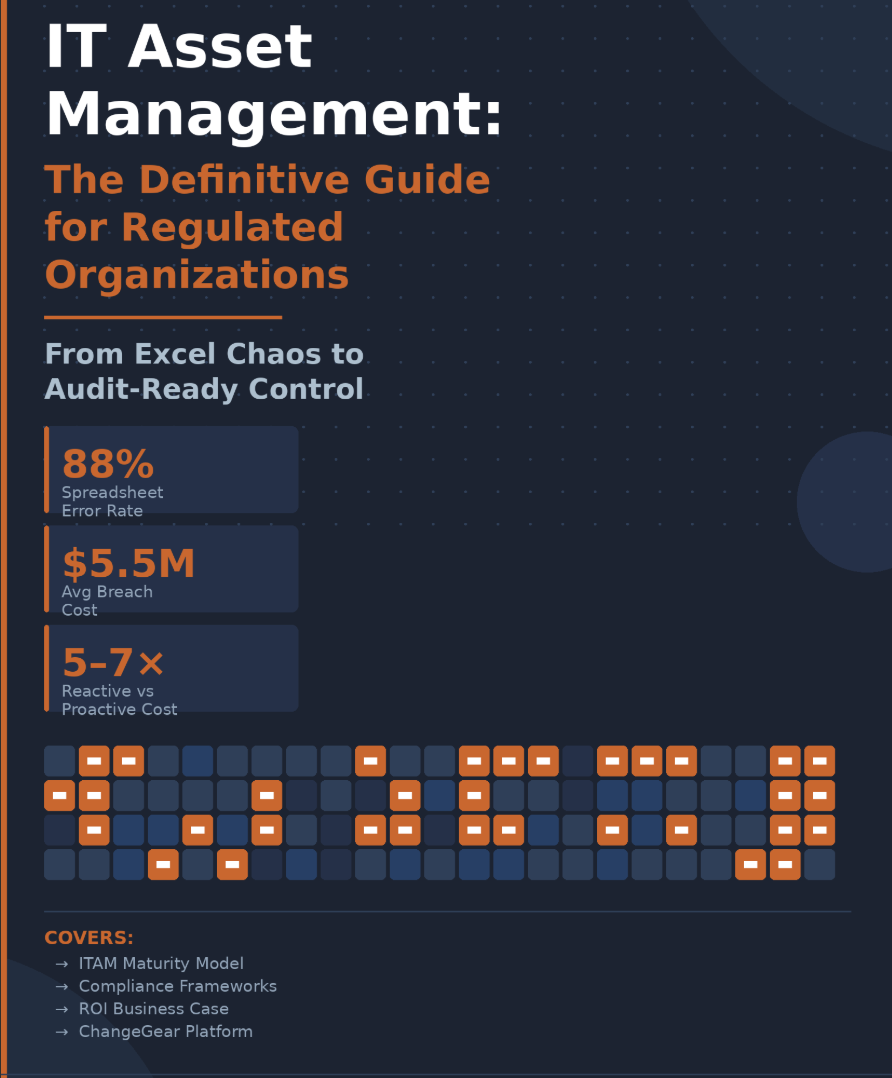
IT Asset Management:
The Definitive Guide for
Regulated Organizations
From Excel Chaos to Audit-Ready Control
A strategic framework for IT leaders in healthcare, financial services, government, and defense — covering the true cost of inadequate ITAM, a five-level maturity model, and a clear path to purpose-built, compliance-ready asset management.
The ITAM Imperative
Organizations in regulated environments face a convergence of pressures that has elevated IT Asset Management from a back-office function to a board-level risk concern. The proliferation of regulatory frameworks — HIPAA, SOX, PCI-DSS, CMMC, FedRAMP, ISO 27001 — combined with increasingly sophisticated vendor audits and rising breach costs, has made the gap between adequate and inadequate ITAM a material financial and compliance risk.
This white paper provides IT leaders with a strategic framework to understand that risk, quantify it, and build the case for a purpose-built ITAM solution. It is grounded in research, honest about migration challenges, and direct about what separates organizations that consistently pass audits from those that spend six figures preparing for each one.
88%of spreadsheet-based asset inventories contain significant data errors
$5.5Maverage cost of a data breach when assets are not properly tracked
5–7×higher cost of reactive vs. proactive ITAM programs
Key Findings
- Most mid-market organizations still rely on spreadsheets — incompatible with modern compliance requirements at scale.
- Ghost assets represent 30–45% of total IT asset counts in organizations without automated discovery, creating financial waste, security exposure, and audit risk.
- Audit preparation for manual ITAM organizations averages $175,000–$450,000 per cycle in direct labor alone.
- Organizations achieving Level 4+ ITAM maturity reduce compliance-related costs by 60–80% within 18 months of deployment.
- For regulated organizations with data sovereignty requirements, cloud-only ITAM is a compliance gap. Genuine deployment flexibility is a prerequisite.
"The audit was the wake-up call, but we should have moved two years earlier. The audit cost us $340,000 in labor and findings. The platform would have cost a third of that over the same period."
— VP of IT Infrastructure, Regional Healthcare System · composite from verified industry reviews
The State of IT Asset Management
The average mid-market organization manages 1,000–10,000 distinct IT assets: laptops, servers, network equipment, mobile devices, VMs, SaaS subscriptions, and cloud infrastructure. Each has a financial lifecycle. Each interacts with users who have access rights. Each is subject to security policy. And in a regulated environment, each is potentially a compliance artifact.
Managing this in spreadsheets isn't just inefficient — it's structurally incompatible with the demands of modern IT. The volume of change events exceeds the capacity of manual systems to keep up accurately.
Why Spreadsheets Fail at Scale
The Spreadsheet ITAM Failure Cascade
1
Initial inventory captured accurately at small scale.
2
Assets change hands faster than manual updates occur.
3
Data accuracy degrades silently — no alerts, no validation.
4
Knowledge concentrates in one or two individuals who "know the system."
5
Audit or incident surfaces the gap — triggering emergency reconciliation at enormous cost.
6
Organization patches the immediate problem but returns to the same tool.
7
Cycle repeats with higher stakes as organizational complexity grows.
ITAM Requirements by Regulatory Framework
| Framework | Industry | Key ITAM Requirement |
|---|
| HIPAA / HITECH | Healthcare | Device inventory, PHI asset tracking, breach notification readiness |
| SOX Section 404 | Finance / Public | IT controls documentation, change management audit trails |
| PCI-DSS v4.0 | Payment Processing | Cardholder environment inventory, EOL software detection |
| CMMC 2.0 | Defense Contractors | Complete asset inventory, unauthorized device detection |
| ISO 27001:2022 | All Regulated | Asset register, ownership assignment, lifecycle records |
| FedRAMP | Federal / Cloud | Continuous asset monitoring, authorized service inventory |
| NIST CSF 2.0 | All Sectors | Full inventory; access control per asset; anomalous activity detection |
| GDPR / CCPA | Global / US | Data asset mapping, processing records, right-to-erasure lifecycle tracking |
An organization subject to even one of these frameworks faces explicit, auditable requirements that cannot be reliably met with manual tracking. Multiple frameworks — which describes virtually every mid-market enterprise in regulated industries — create compounding evidence requirements that demand a platform answer.
Quantifying the Cost of Inadequate ITAM
The business case for ITAM is consistently undermined by failure to capture its full cost. Platform cost is visible and specific. The cost of not having a platform is distributed across dozens of line items — absorbed into IT labor overhead and buried in audit prep activity accepted as "normal."
Direct Waste
- Software license waste: 20–35% of licenses are unused or duplicate without automated tracking. On a $2M software spend, that's $400K–$700K in annual waste.
- Hardware in storage: 8–15% of total fleet sits in untracked storage, triggering duplicate purchases to meet perceived shortages.
- Zombie contracts: Maintenance auto-renewing on decommissioned assets represents a consistent 3–7% of total IT support spend.
- Duplicate vendor agreements: Consolidation routinely yields 15–25% savings on affected licenses.
Audit & Compliance Costs
| Cost Component | Manual ITAM (per cycle) | Purpose-Built ITAM |
|---|
| IT staff audit prep labor | $80,000 – $150,000 | $8,000 – $20,000 |
| External consultant prep | $40,000 – $120,000 | $0 – $15,000 |
| Emergency license purchases | $20,000 – $80,000 | $0 – $5,000 |
| Finding remediation | $30,000 – $200,000+ | $0 – $10,000 |
| Repeat audit surcharge | $25,000 – $75,000 | Rare |
| Total per cycle | $195,000 – $625,000+ | $8,000 – $50,000 |
Security Incident Risk
You cannot monitor, patch, or manage access to assets you don't know you have. Ghost assets — present in the environment, absent from inventory — are precisely the attack surface sophisticated threat actors exploit. IBM's Cost of a Data Breach Report places the global average breach cost at $4.88M, with regulated industries exceeding $9M.
📊 5-Year Cumulative Cost: Spreadsheet ITAM vs. ChangeGear
Representative 1,000-device organization with $2M annual software spend ($K cumulative)
Operational Inefficiency
Conservative estimates put ITAM-related manual labor at 8–14 hours per week per IT staff member. At $70/hour blended, a four-person team spends $116,000–$204,000 annually on activities a Level 4 ITAM system would automate.
The ITAM Maturity Model
Effective ITAM transformation requires a clear framework for assessing current capability and defining a progression path. The five-level model below grounds each level in specific operational characteristics, risk profiles, and compliance postures.
| Level | Name | Description | Risk | Compliance |
|---|
| L1 | Reactive | No formal process. Ad-hoc spreadsheets or nothing. Discovery only after incidents. | Highest | Non-compliant |
| L2 | Aware | Basic spreadsheet maintained by one person. No automation or lifecycle management. | High | Partial |
| L3 | Defined | Documented process, basic tooling. Some automation. Lifecycle stages defined but not enforced. | Moderate | Approaching |
| L4 | Managed | Purpose-built platform. Automated discovery. Integrated with service desk and procurement. Audit-ready. | Low | Compliant |
| L5 | Optimized | AI-driven ITAM with predictive analytics, automated remediation, and continuous compliance posture. | Minimal | Continuous |
Most mid-market regulated organizations sit at Level 1 or 2. The Level 2 → Level 4 transition is the highest-value move in the model — the shift from person-dependent, error-prone tracking to system-enforced, continuously accurate, audit-ready asset management.
The Level 2 → Level 4 Transition
1
Data foundation: A baseline inventory accurate enough to migrate into a structured system. Triage existing data — what's reliable, what needs verification, what must be discovered fresh.
2
Process redesign: Workflows for procurement-to-asset creation, onboarding-to-assignment, offboarding-to-recovery, and decommission-to-disposal — documented, enforced, and automated.
3
Platform selection: A tool matching your deployment requirements (on-premises, cloud, or hybrid) that integrates with existing systems and provides compliance reporting for applicable frameworks.
📅 Implementation Timeline: Level 2 → Level 4
Weeks 1–2: Network discovery scan and baseline gap analysis
Weeks 3–6: Data triage, cleanup, and initial platform migration
Weeks 7–10: Core workflow activation (procurement, onboarding, offboarding)
Weeks 11–14: Integration with service desk, HR, and financial systems
Weeks 15–18: Compliance reporting configuration and first audit-readiness review
Month 6+: Continuous improvement — lifecycle optimization, AI-assisted anomaly detection
The Regulated Industry Imperative
For regulated organizations, ITAM is not a discretionary investment — it is a prerequisite for operating. These organizations face external scrutiny of their asset management practices, defined evidence standards, and legal and financial consequences for failures that non-regulated organizations do not.
Healthcare: Patient Safety Stakes
HIPAA requires every device capable of accessing PHI to be inventoried, controlled, and monitored. The average healthcare data breach costs $9.77M — the most expensive category for 13 consecutive years. The audit question "show me a complete, current inventory of all devices with EHR access" requires a platform answer, not a spreadsheet one.
Financial Services: SOX and PCI-DSS Controls
SOX Section 404 requires documented, effective internal controls over IT systems affecting financial reporting. A material weakness must be disclosed in the annual report. PCI-DSS v4.0 has strengthened inventory requirements for cardholder data environments — manual maintenance is now specifically identified as a risk factor by QSAs.
Government and Defense: CMMC Existence Test
For U.S. defense contractors, CMMC 2.0 has made ITAM an existence condition for government contracting. Practice CM.L2-3.4.1 requires a complete asset inventory throughout system development lifecycles. Without it, organizations cannot hold contracts involving Controlled Unclassified Information. FedRAMP requires continuous asset monitoring within an authorization boundary — making on-premises or FedRAMP-authorized deployment a compliance requirement.
"We evaluated seven ITSM platforms before selecting ChangeGear. The deciding factor was on-premises deployment with full feature parity. Our FedRAMP boundary meant cloud-only was not an option."
— IT Director, Federal Civilian Agency · composite from verified Gartner Peer Insights reviews
The ChangeGear Approach to ITAM
ChangeGear was designed for organizations most poorly served by the market: mid-market and regulated-industry organizations that need enterprise-class asset management without enterprise-class implementation complexity. The platform reflects deliberate architectural decisions that differentiate it from the spreadsheet status quo and incumbent enterprise ITSM platforms alike.
🏢
On-Premises or Cloud — Full Feature Parity
Deploy on-premises with identical functionality, security updates, and AI capabilities as the cloud deployment. No feature-gating by deployment model.
⚖️
Compliance by Design
Audit trails, change records, evidence packages, and compliance reporting are built into every workflow — not add-ons requiring professional services to activate.
🔗
ITAM + ITSM in One Platform
Asset records, service records, change records, and CIs live in the same platform, linked by design. No reconciliation between systems.
🤖
AI-Native Since 2017
Luma AI Copilot, predictive analytics, and intelligent categorization were built in from 2017 — not retrofitted after the generative AI surge.
⚡
Weeks, Not Months
Production-ready in weeks, not the 12–18 months typical of enterprise ITSM. No systems integrator required.
📊
Reports for Every Stakeholder
IT dashboards, CFO reports, CISO security views, and auditor evidence packages — all from the same underlying data.
Competitive Comparison
| Capability | Spreadsheet | Generic ITSM | ChangeGear ITAM |
|---|
| On-premises deployment | ✗ N/A | ⚠ Rarely | ✓ Full feature parity |
| Compliance audit trails | ✗ Manual logs | ⚠ Requires config | ✓ Built-in, automatic |
| ITAM + ITSM unified | ✗ No | ⚠ Fragmented | ✓ Native integration |
| Automated asset discovery | ✗ Manual | ⚠ Module/add-on | ✓ Built-in agents |
| Lifecycle management | ✗ No | ⚠ Limited | ✓ Full lifecycle workflows |
| Multi-framework compliance | ✗ No | ⚠ SOX/ITIL only | ✓ HIPAA, SOX, CMMC, ISO+ |
| AI-native capabilities | ✗ No | ⚠ Bolt-on | ✓ Native since 2017 |
| Implementation time | — Days | ✗ 12–18 months | ✓ Weeks |
| Mid-market pricing | ✓ Free (until audit) | ✗ Enterprise-priced | ✓ Purpose-fit packaging |
ITAM Best Practices for Regulated Organizations
The following best practices are drawn from organizations that have successfully transitioned from manual to mature ITAM programs — validated in post-implementation reviews, audit retrospectives, and IT community discussions.
1 · Establish a Single Source of Truth First
The most common mistake in ITAM transformations is optimizing processes before underlying data is accurate and consolidated. One authoritative record for every asset, trusted by all stakeholders. Resist the temptation to maintain "temporary" parallel systems during migration.
2 · Automate Discovery — Never Rely on Manual Entry Alone
Modern IT environments change faster than humans can track manually. Automated discovery — network scanning agents, endpoint integrations, cloud API connectors — should be the primary mechanism for keeping records current. Organizations that implement automated discovery consistently find 20–40% more assets than their manual inventory documented.
3 · Own the Full Lifecycle — Procurement to Disposal
ITAM that begins at deployment and ends at decommission is incomplete. Each lifecycle transition should trigger a workflow event: purchase order to asset creation; receipt to deployment; moves and changes to record updates; refresh planning to timely replacement; secure disposal with documented chain of custody.
4 · Connect ITAM to Financial Management in Real Time
Organizations with real-time alignment between IT asset records and financial records eliminate the annual reconciliation project. CFOs make capital allocation decisions on current data. IT makes refresh decisions with full financial context. No more audit risk from records that don't match operational reality.
5 · Treat Compliance as a Continuous Posture, Not a Periodic Event
The most expensive approach to compliance is the periodic fire drill. The most effective: continuous compliance — maintaining evidence as a natural output of normal ITAM operations. This requires a platform that generates audit trails for every asset change and compliance reports for every applicable framework.
6 · Plan for Key Person Independence From Day One
Any ITAM program dependent on a single individual's knowledge is one departure away from crisis. Documented processes, training programs, and enforced workflows make ITAM a resilient institutional capability — not a personal skill.
Building the Business Case
The ITAM investment conversation is hampered by an asymmetry of visibility: platform cost is visible and specific, while the cost of inadequacy is distributed and hidden. Building an effective business case means making the hidden costs visible — in the financial terms decision-makers use.
ROI Framework
Representative figures for a 1,000-device organization with $2M annual software spend, subject to SOX and ISO 27001. Substitute your actual figures.
| Cost Category | Status Quo (Yr 1) | With ChangeGear | Annual Savings |
|---|
| Software license waste (20% of $2M) | $400,000 | $60,000 | $340,000 |
| Audit preparation labor | $220,000 | $35,000 | $185,000 |
| Maintenance on decommissioned assets | $85,000 | $12,000 | $73,000 |
| Duplicate hardware purchases | $120,000 | $15,000 | $105,000 |
| IT labor for manual ITAM tasks | $165,000 | $40,000 | $125,000 |
| Risk-adjusted incident cost | $380,000 | $65,000 | $315,000 |
| Total | $1,370,000 | $227,000 | $1,143,000 |
📊 Annual Cost Breakdown: Before vs. After ChangeGear
Representative 1,000-device org ($K) — status quo vs. purpose-built ITAM
Payback Period
Platform cost for a 1,000-device ChangeGear deployment is typically $80,000–$150,000 annually. Against $1,143,000 in savings, the payback period is approximately 1–2 months. Even halving the estimates to account for ramp-up uncertainty, payback remains under six months.
💡 Presenting to Leadership
Frame as risk elimination, not IT tooling. "We cannot produce audit-ready asset evidence on demand" is a governance conversation.
Quantify the status quo cost first. Make leadership see current spending before presenting the platform cost.
Use a compliance trigger if available. An upcoming audit or recent finding creates urgency that abstract ROI cannot.
Show payback prominently. Sub-12-month payback is unusual in IT capital requests. Lead with it.
Address migration concerns directly. Acknowledge data cleanup is work, and present a realistic timeline.
The Window for Proactive Action
Organizations that build durable compliance advantage address ITAM maturity proactively — before an audit finding, a security incident, or an M&A process forces the issue. The cost differential between proactive and reactive ITAM investment is consistently 3–7×.
The regulatory environment is tightening. CMMC 2.0 has made asset inventory a contract requirement. PCI-DSS v4.0 has strengthened evidence standards. HIPAA enforcement continues to name inadequate asset management as a contributing factor in breach findings. Every revision of every major framework has moved in the same direction.
Organizations that invest in ITAM maturity now are building infrastructure that compounds in value — improving security posture, financial planning, vendor negotiations, workforce productivity, and compliance simultaneously. Platform cost is a one-time adoption decision. The cost of inadequacy is a permanent and compounding tax.
Level 4Target maturity: purpose-built, integrated, audit-ready ITAM
90 daysTypical time to measurable ROI after ChangeGear deployment
60–80%Reduction in compliance costs for Level 4+ organizations
Next Steps
1
Conduct an honest maturity assessment using the five-level model in Section 3.
2
Quantify your status quo cost using the ROI framework in Section 7 with your actual figures.
3
Document your deployment requirements — whether on-premises, cloud, or hybrid is required by your compliance obligations.
4
Map your regulatory frameworks against the requirements table in Section 1 to identify specific platform requirements.
5
Schedule a ChangeGear evaluation focused on your regulated industry requirements, framework coverage, and deployment model.
"The question is not whether your organization needs better IT asset management. The question is whether you address it on your terms — or wait for an external event to force the issue."
— Serviceaide ITAM Practice
Glossary of ITAM Terms
Asset Discovery
Automated identification of IT assets via network scanning, endpoint agents, and system integrations. Foundational to accurate ITAM.
CMDB
Configuration Management Database. Tracks relationships between configuration items. Distinct from ITAM: CMDB focuses on system relationships; ITAM focuses on financial and lifecycle attributes.
CMMC 2.0
Cybersecurity Maturity Model Certification. U.S. DoD framework requiring defense contractors to demonstrate cybersecurity practices including comprehensive asset inventory.
EOL (End of Life)
The date after which a product no longer receives security patches. Running EOL assets is a compliance violation under most security frameworks.
FedRAMP
Federal Risk and Authorization Management Program. U.S. government compliance framework for cloud service providers used by federal agencies.
Ghost Asset
Any IT asset present in the physical environment but absent from inventory. Represents security risk, financial waste, and compliance exposure.
HIPAA
Health Insurance Portability and Accountability Act. Governs protection of PHI with extensive IT controls requirements including asset management.
ITAM
IT Asset Management. The discipline of tracking, managing, and optimizing the lifecycle of IT assets — hardware, software, licenses, and services.
ITSM
IT Service Management. Most effective when integrated with ITAM in a unified platform.
Key Person Risk
Risk created when critical institutional knowledge concentrates in a single individual. A significant vulnerability in manual ITAM programs.
License Compliance
Having valid licenses for all deployed software matching actual deployment counts. Non-compliance creates vendor audit liability and financial exposure.
PCI-DSS
Payment Card Industry Data Security Standard. Security requirements for organizations processing, storing, or transmitting cardholder data.
SAM
Software Asset Management. A subset of ITAM focused on software licenses, deployments, and compliance. Often the highest-ROI component of an ITAM program.
SOX
Sarbanes-Oxley Act. Requires public companies to demonstrate documented, effective internal controls over financial reporting — including IT controls governing financial systems.